Showing posts with label politics. Show all posts

Thursday, December 27, 2012

Saul Alinsky's Rules


In the right-wing blogosphere there has long been a theme that says that Obama is a disciple of the old lefty, Saul Alinsky, and that he and Hillary Clinton are (literally) playing from his rulebook, an actual book called Rules for Radicals. Hillary's senior thesis at Wellesley was on Alisnky, so they say. I'm not interested in that issue. BHO's behavior won't look any worse (or better) to me depending on where he learned it. But some quotes from that book interested me.

I don't really know anything about this guy, except that leftists often mention him as as a sort of wise, lovable old coot, a sort of leftie Yoda.

I found an electronic copy of the book and read (most, I think) of a chapter titled "Tactics." My jaw dropped. The core of the chapter is thirteen tactical rules for changing the world (in good ways, supposedly). Most of them belong with the sort of tactical advice you can read in The Prince or Mein Kampf.

Yoda he is not. Look at this. (And as you read, try to imagine Martin Luther King, Jr., Malcolm X, Gandhi, or Thoreau saying any of this.)

RULE 1: "Power is not only what you have, but what the enemy thinks you have."

One thing this seems to mean, if we read it in connection with some of the rules that follow, is that his goal is to intimidate those who disagree with him, controlling them through fear, and not to convince them of something by appealing to their mind or conscience. Note also that this power seems to be based on deception of some sort.

RULE 2: "Never go outside the expertise of your people." It results in confusion, fear and retreat. Feeling secure adds to the backbone of anyone.

RULE 3: "Whenever possible, go outside the expertise of the enemy." Look for ways to increase insecurity, anxiety and uncertainty.Rule 2 is actually good advice. Base your arguments on your own experience and that of your audience. Knowing that your case is based on solid evidence increases confidence and dispels fear.  But notice that he applies this valid principle in reverse against others. Spreading this disabling fear far and wide is just what Rule 3 advises.

RULE 4: "Make the enemy live up to its own book of rules." If the rule is that every letter gets a reply, send 30,000 letters. You can kill them with this because no one can possibly obey all of their own rules.

This rule might have been defensible if it meant that you should expose hypocrisy or take advantage of the impracticality of your opponent's moral code. But that is not what he has in mind. He says that everyone is vulnerable to this tactic, not just hypocrites. And the example he gives, of answering every letter, is actually a decent and sensible rule. He is advising you to take advantage, not of your opponents' hypocrisy and foolishness, but of their decency and their ideals.  And to take advantage of the fact that they can't do something that, according to him, nobody could do anyway.

RULE 5: "Ridicule is man's most potent weapon." There is no defense. It's irrational. It's infuriating. It also works as a key pressure point to force [note his word choice here] the enemy into concessions.

I take it the idea here is something like this. Instead of engaging in a debate with Dick Cheney about the ethics of torture -- where you'll end up dealing with a mass of theories and supposed facts -- make fun of him for shooting his friend in the face on a hunting expedition.. If you do it right, people will just start to snicker when he shows up on TV. They won't hear a word he says. It will be just as though you have turned off his microphone. If you are really lucky, he will lose his temper and look even worse.

As with Rule 13, below, the basic strategy here is the respond to speech by delegitimizing the speaker. I can't think of a single practice (short of the use of threats and violence) that is more deeply inimical to the basic principles of civilized discourse.

RULE 8: "Keep the pressure on. Never let up." Keep trying new things to keep the opposition off balance. As the opposition masters one approach, hit them from the flank with something new.

In other words, disable his opponent's capacity to reason.

RULE 9: "The threat is usually more terrifying than the thing itself." Imagination and ego can dream up many more consequences than any activist.

Need I say more?

RULE 10: The major premise of tactics is the development of operations that will maintain constant pressure on the opposition. It is this unceasing pressure that results in the reactions from the opposition that are essential for the success of the campaign.

Translation:  Provoke your opponents to doing irrational things that are not in their interest, but are in yours.

RULE 11: "If you push a negative hard enough, it will push through and become a positive." Violence from the other side can win the public to your side because the public sympathizes with the underdog.

Get them to abandon reason altogether and resort to violence. Now you are a martyr. Yay! you win!

RULE 13: Pick the target, freeze it, personalize it, and polarize it." Cut off the support network and isolate the target from sympathy. Go after people and not institutions; people hurt faster than institutions.

I think this rule is the most evil one of the lot, partly for the reason I gave under Rule 5. But there is more.

I have long been convinced that the problems in the world are due to bad institutions and not ultimately to bad people. Bad institutions reward bad behavior, punish good behavior and distort people's ideas. When bad people are at the center of things, it is generally because we have created an institution in which the only people who can flourish are ones with certain moral vices.

This truth, that "it's not the people, it's the system," was one of Marx's most distinctive ideas, and it is responsible for what is true in his doctrine.

It makes it hard to reform the world, however, because people don't get energized about "institutions," and even find them difficult to think about. The issue has to be personalized somehow.

What Alinsky is recommending is that you personalize the issue in the cheapest, most duplicitous, and cruelest way: pick out hate figures and demonize them.

If old Saul's disciples are indeed in the saddle, we are headed straight for Nastyville. I'm not going to enjoy the ride one bit.

Sunday, January 01, 2012

Moral Thinking in the Real World

This is a very interesting article on the OWS movement by the psychologist Jonathan Haidt.

I've been following his work at a distance for some years now. He and his colleagues analyse real-world moral thinking based on "six clusters of moral concerns": "care/harm [eg., compassion for the underdog], fairness/cheating [here, distributive justice has a place], liberty/oppression, loyalty/betrayal, authority/subversion, and sanctity/degradation."

Among their findings: liberals and libertarians think almost exclusively in terms of the first three clusters. Social conservatives use all six, extensively. We liberals and libertarians, by comparison, live in a morally truncated world. At a fundamental conceptual level, their moral world is much richer.

The signs at Zucotti park, he finds, are extremely typical of the left-liberal Weltanschauung.

The most interesting thing in this particular article is the Machiavellian advice he offers OWS at the end:
[I]f the protesters continue to focus on the gross inequality of outcomes in America, they will get nowhere. There is no equality foundation. Fairness means proportionality, and if Americans generally think that the rich got rich by working harder or by providing goods and services that were valued in a free market, they won’t support redistributionist policies. But if the OWS protesters can better articulate their case that “the 1 percent” got its riches by cheating, rather than by providing something valuable, or that “the 1 percent” abuses its power and oppresses “the 99 percent,” then Occupy Wall Street will find itself standing on a very secure pair of moral foundations.
When I read this I realized that, by George, equality is not to be found in his six "clusters." What you see is fairness, which (pace Rawls) is not the same thing. Haidt thinks of fairness as a matter of proportionality, not equality. Equality means treating everyone the same. Proportionality means treating people in appropriately different ways.

Then another realization hit me: if he is right, academic political philosophy is even more out of touch with the way normal people think than I had thought it was. Whether you look at Arneson or Cohen or Dworkin - or the vast horde of Rawlsians - it is pretty much wall-to-wall egalitarian. Their big issue is: which kind of eqalitarianism is the right one? The one thing they assume is the fundamental moral foundation for political thinking is something that most Americans, and possibly most human beings, don't really care about at all.

Tuesday, September 13, 2011

Is Social Security a Ponzi Scheme?

Thanks to the Republican debates, the idea the Social Security is a Ponzi scheme is back in the news! I thought I would repost a comment I published on this notion the last time it turned up, during the furor about the Madoff case. Also see my comment on the complexities of this idea here.

Carlo Ponzi had a brilliant idea -- brilliant at any rate by the standards appropriate to judging the intelligence of criminals: Invite people to invest their money in your scheme, and pay them surprisingly large returns. But these payments are merely taken out of the deposits of new customers, who will be payed from deposits of still newer customers. But there really are no investments involved, and they rest of the money isn't going anywhere but into the conman's pockets.

Now that the economic downturn has exposed Bernie Madoff's truly despicable crime, the largest Ponzi in history, such schemes are in the news again, and some libertarians are making the familiar claim that the Social Security Administration is itself a Ponzi pyramid, far larger even than Madoff's . If so, the notion that Madoff's is the biggest such scam ever are in fact wrong. His is merely the largest private one. No one does it like the state.

Is it true that Social Security is a Ponzi scheme? I don't think it is (nor is the related idea true that SS is "insolvent"). I think the comparison does bring out features of the SSA that are ethically problematic, but the ethical problems are rather different from those that consigned Mr. Ponzi to prison (and, were there only such a place, to Hell).

The SSA pays Grampa Jones with money extracted from Jones Jr., who will eventually be paid with money extracted from Jones III. There is that much resemblance to a Ponzi.* The difference of course is that everyone knows from the outset that this is what Social Security is like.

As Nat pointed out to me recently, one of the important features of a Ponzi scheme, very often, is that the swindler sometimes avoids making payments to his victims. "Wow that's a huge dividend! Why don't you just reinvest it for me? I'll make even more!" Why sure, I'll reinvest it for ya. Heh heh. With SS, no beneficiary would ever do that because no one is under the illusion that this is an investment plan.

Social Security is nothing but a conduit by which wealth is extracted from those who produced it and transferred to those who did not. Of course, that is also true of a Ponzi scheme. But the difference is that Pozis do it with fraud, while SS does it with force. Social Security is to a Ponzi scheme as coercion is to deceit.

That is not a morally trivial difference. The people who received dividends from Madoff were benefiting from acts that violated the rights of others. But they were unwitting and innocent beneficiaries. What is Grampa Jones? He may be innocent, but not because he is unwitting. The ethics of his position are more complex and murky than those of Madoff's victims.

There is a particularly vicious sort of coercion involved in the SS system that many others have noticed. Suppose that we the people decide that we want to liquidate the system. What do we do with Grampa? All his working life he has been paying money into this growing, spreading system. Can we abandon him? And where will the money to support him come from? And how will we refund the money that the still-productive who have paid, usually enormous amounts,** into the system? They would have put part of that money into private retirement accounts, but now they can't do so, because the SSA took it from them.

That is why the economic sterility of the system is ethically problematic: not because it is fraudulent, but because it makes it all the more coercive. There is no fund of capital that might have enabled us to liquidate it. The generation that voted SS into being were handcuffing us to a monster. In this way, what they did was profoundly anti-democratic.
Update: Also, see this.
______________________________________
* Interestingly enough, when Junior pays more that Gramps needs, a trust fund accumulates, but by law this money must be spent on government bonds. In other words, it goes into the pockets of the perpetrator of the scheme. Again, like a Ponzi snow job.

** In 77% of cases, the employee's contribution plus that of the employer (which ultimately comes out of the employee's hide as well) is greater than the entire federal income tax paid by the worker.

Saturday, August 27, 2011

Crying Wolf


As a number of people have pointed out, Hurricane Irene is the Apocalypse that wasn't. Indeed, this article suggests that a substantial number of people simply didn't believe the shrill warnings we got from the politicians and the press in the first place.

It puts one in mind, does it not, of a certain Aesop's fable, known to scholars as number 210 in Curry's catalog. (Okay, I'm a pedant. It's my job. So shoot me.) Here it is:
There was a boy tending the sheep who would continually go up to the embankment and shout, 'Help, there's a wolf!' The farmers would all come running only to find out that what the boy said was not true. Then one day there really was a wolf but when the boy shouted, they didn't believe him and no one came to his aid. The whole flock was eaten by the wolf. [Aesop's Fables. A new translation by Laura Gibbs. Oxford University Press (World's Classics): Oxford, 2002.]

Fear seems to be an abundant and inevitable product of the democratic state. I have commented earlier that this means that, if its leaders have their way, its citizens will live in a permanent state of being more or less scared out of their wits.

I now realize that there is also a down side if they don't have their way, and people just stop believing what they are told. There is a legitimate role for alarms and warnings, if they are overused they will cease to work.

Update: On the crying wolf theme, see the last paragraph of this.

But maybe the best comment is this.

Monday, August 15, 2011

Jon Stewart on Media Coverage of Ron Paul


Very funny -- and literally true. Except for the part where he says that Fox ought to like this guy. Nuh-uh. They know what they are doing. They're just bigger fans of perpetual war than you think.

Thursday, August 11, 2011

Live-Blogging the Republican Debate


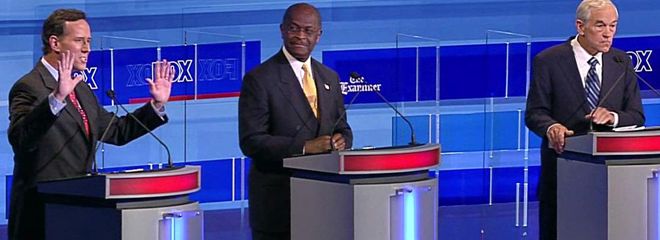
Well, I expect to hear a lot of Obama-bashing tonight, and it was there already in the first two answers (Bachman and Romney).

Sad to see Gary Johnson again not allowed to participate. I've been following him on Twitter, and I noticed that he seemed depressed. "People will start to notice us," he said. That's not exactly rallying the troops.

Romney, asked if he would have vetoed the budget bill, seemed to dodge the question.

Ron Paul is talking too fast, as usual.

Pawlenty repeated his charge that Bachman's "record of accomplishment in Congress is non-existent." Apparently this means she hasn't written legislation that passed both houses. Isn't that an unfair criticism? The last five years have been bad ones for someone with her ideology to pass legislation. Her answer was that she has been leading the resistance, which seems like the right answer to me.

Chris Wallace asks Gingrich about his staff quitting on him and Gingrich, and Newt gets all huffy. The crowd seems to like it, but I didn't.

Cain: I am learning. Well, good, but Presidential OJT hasn't worked that well for us.

Panel member Byron York: He has 19th-century hair.

Someone once described Rick Santorum as having "a punchable face."

Romney just came out as a tenther! The feds only get to do what the Constitution says they can do. That's his main defense of Romneycare: this ought to be done by the states.

Pawlenty is taking swings at Romney and Bachman, both in the top three. Someone has been telling him to become Macho Man.

Ron Paul says that under the federal Constitution, the states have a right to do bad things (like force people to buy health insurance). True. Then Santorium goes berserk, saying that this means that they have the right to legalize polygamy and impose enforced sterilization. What a complete moron.

Gingrich keeps objecting to tough questions as "gotcha questions." Oh, just answer them, dang it!

Quite a heated exchange between Santorum and Ron Paul on Iran policy! I'm with Paul on this one, as you may know.

Paul points out that Bachman's "no miranda rights for terrorists" involves convicting someone of being a terrorist without due process.

She also would do "anything" to prevent Iran from getting a nuke.

If you thought Afghanistan and Iraq were quagmires, just wait until we invad Iran, Michelle!

I could swear I just heard Santorum say Iran will destroy civilization as we know it. And people used to say the Ronster is the crazy one.

The audience keeps booing tough questions. Bachman has quoted the Bible saying wives should be subissive. Would she be submissive as pres? Her answer is that she interprets the Biblical notion of submissiveness as "respect."

Romney says marriage should be a federal issues. With a constitutional amendment banning gay marriage.

Paul takes a laissez-faire position on what marriage is. Good!

Now they're fighting about who is the most pro-life. So far, two are in favor of criminal sentences for doctors who perform abortions. Why not the woman? I've never understood that. If it's murder, isn't she at least as guilty as the doctor? The pro-life Weltanschauung is an impenetrable mystery to me.

Gingrich just took a more or less Paulian position on the Federal Reserve. Amazing how much more mainstream Paul is than he was four years ago. And he hasn't moved an inch!

I thought they were going to spend the who evening attacking Obama. No, they mixed it up with each other, plenty.
They are summarizing now. The last event I live-blogged was an hr. long Obama speech. It was excruciatingly boring. This 2-hr. event was much more interesting. Frightening at times, but interesting.

How this debate affected my opinion of the candidates:

Romney: About the same.
Bachman: Lower (on the issues).
Paul: Higher.
Pawlenty: Lower (as a person).
Cain: Higher. Fixed some earlier mistakes.
Santorum: Lower. Much lower. In every way.
Huntsman: Lower (on the issues).
Gingrich: Higher on the issues, lower as a person. At this moment he's being interviewed on TV, and he's still bitching about Chris Wallace's questions.

Cris Wallace: Higher!

Wednesday, August 10, 2011

The Mystery of the English Riots

I've been struggling to understand the arson, looting, and senseless violence in England over that last four days. That sort of behavior is so alien to me that this is like understanding beings from another planet. This article, though tainted by the shortcomings of the author's Tory priorities, seemed helpful to me. He says, in effect, these people are not from another planet, they are from the future. The may or may or may not be from your future. For sure they are out of a futuristic novel and movie call A Clockwork Orange. Say hello to Alex and his droogies!

The idea is that the system, one of the wealthiest welfare states on Earth, has created a large underclass of young people with no marketable skills and little or no interest in being productively employed, kept in useless idleness on the dole.

The distinguished political philosopher John Rawls claimed that if we arrange social institutions so that inequalities are in the interest of the least well-off people this will boost their self-esteem because it will show that we care about and value then. He never went into just what institutions fill this bill (with commendable humility, he figured he is not qualified to do this, not being an economist) but it seems to me that for this particular point, he would have to accept as an example of such a system getting a monthly check in the mail of money taken from the most well-off people. The stuff the system gives them, just for being the worst-off brings a convincing message: you are good.

No it doesn't. The message it carries is more like: "So sorry you can't seem to fend for yourself! Well, here's some stuff produced by people who, unlike you, can fend for themselves. Hope things start lookin' up for you! Cheers!" How self-esteem-boosting is that?

Rawls was a brilliant man, but he was a rotten psychologist. Much better were Dostoyevsky (in Notes from the Underground), Nietzche, and Erich Hoffer. These people would tell you that people don't get a sense of dignity and self-worth by being paid for nothing. They get it from a sense of efficacy (that is, power), and this can only come from their own action. And if for some reason they can't or won't act constructively, then they will act destructively, if only to prove that they are still human beings and have to be taken seriously.
_______________________________
Update: For an interpretation similar to the above-linked article (but in the leftist Guardian) see this.

Thursday, July 28, 2011

Hot Speech and Responsibility for Evil

In the days since the atrocities in Oslo and Utøya, commentators have rushed to associate the killer with ideas they already hate on other grounds. I've already said that a lot of this talk is disingenuous and springs from some very nasty motives, but it does raise an interesting issue.

Obviously, what these talkers are trying to do is make their opponents feel/seem responsible for evil acts committed by others. The theory is that there can be vicarious responsibility via speech and thought. The issue: Can your speech and thoughts make you responsible for evil acts you do not actually commit? If so, when?

Well, clearly I would be responsible for a murder if I
  1. Order it done.
  2. Promise to pay for it being done.
  3. Personally urge the killer to do it.
  4. Publicly advocate it, thereby influencing the eventual killer.
These all seem pretty obvious to me. There is such a thing as vicarious responsibility, and speech and expressed thoughts can create it.

The interesting part is 3 and 4, which bleed over into other categories, where some distinctions have to be made very carefully. Let me give you an illustration. Here is the account of the run-up to the horrific Thirty Years' War in the vol. VII of the Durants' The Story of Civilization:
The struggle between Lutherans and Calvinists was as bitter as between Protestants and Catholics ... for each alteration of roles between persecutors and persecuted left a heritage of hate. ... What Melanchthon called rabies theologorum raged as seldom before or after in history. The Lutheran Pastor Nivander (1581) listed forty characteristics of wolves and showed that these were precisely the distinctive marks of Calvinists. He described [ie., with approval] the dreadful deaths of leading anti-Lutherans; Zwingli, he said, having fallen in battle, "was cut into straps, and the soldiers used his fat -- for he was a corpulent man -- to grease their boots and shoes." Said a Lutheran pamphlet of 1590: "If anybody wishes to be told, in a few words, concerning which articles of the faith we are fighting with the diabolical Calvinistic brood of vipers, the answer is all and every one of them, ... for they are no Christians, but baptized Jews and Mohammedans." ... "These raging theologians," mourned a Protestant writer in 1610, "have so greatly augmented and aggravated the disastrous strife among the Chistians who have seceded from the papacy, that there seems no hope of all this screaming, slandering, abusing damning, anathematizing, etc., coming to an end before the advent of the Last Day.
In these ravings, the rabid theologians are not in so many words urging people to violence, but in depicting their opponents as dangerous subhuman animals (wolves, vipers) and "Mohammedans," they are depicting them as what the Nazis called Leben unwert des Lebens, live unworthy of life. If you talk like this on the eve of murder and mayhem, I think you do share some responsibility for the result. (For another example, scroll to 23:00 in this video: "First, the victims were ridiculed....")

As I say, though, distinctions have to be made. I see a big difference between depicting your opponents as animals, devils, or monsters and, on the other hand, depicting them as murderers, criminals, and thieves -- provided only that you have real evidence that the latter sort of depiction is accurate.

Politics is about force and violence, and that is why any political ideology can become a motive for assassination as long as the ideology is out of power. Politics is a theater of real injustice and real oppression, and it naturally makes people angry. The fact that the Norwegian Muslim-hater read some books by American conservatives does not make them responsible for murder, not even if they somehow caused him to carry out his crimes. It depends on what they said and how they said it. Responsibily requires more than mere causation. It also requires mens rea, a guilty mind. I draw the line between anger and even rage based on considerations of justice on the one hand, and dehumanization on the other.

How the Heck Can Politics Make You Rich (Legally)?


This video answers a question, albeit with just one sentence, that I have often wondered about. I think of it like this:

Thomas Jefferson's finances were devastated by his two terms as President. His only source of income was his farm, which he had to neglect while in Washington. Meanwhile, he had to pay the salary of at least one staff member out of his own pocket.

Today, on the other hand, politicians often become (by my standards) fabulously rich while in office (yes, this does include Obama).

The question is, how is this possible without breaking the law? Why aren't these guys being led off in leg irons? How do they do it?

The answer, apparently, is by means of practices that in the business world would be called "insider trading."

George Washington Plunkitt called a similar practice "honest graft":

There's an honest graft, and I'm an example of how it works. I might sum up the whole thing by sayin': "I seen my opportunities and I took 'em."

Just let me explain by examples. My party's in power in the city, and it's goin' to undertake a lot of public improvements. Well, I'm tipped off, say, that they're going to lay out a new park at a certain place.

I see my opportunity and I take it. I go to that place and I buy up all the land I can in the neighborhood. Then the board of this or that makes its plan public, and there is a rush to get my land, which nobody cared particular for before.

Ain't it perfectly honest to charge a good price and make a profit on my investment and foresight? Of course, it is. Well, that's honest graft.

Shouldn't this sort of insider trading be illegal? Do the objections to Plunkitt's "honest graft" apply to them?

(Hat-tip to Amy Alkon for the video.)

Thursday, June 09, 2011

The Private Lives of Politicians: Should We Care?


Liberal blogger Matthew Yglesias has said that there is no reason to pay any attention to Weiner's private behavior: his record tells you everything you really need to know about his character -- at least the part of it that matters. Above, libertarian columnist Jack Hunter takes, curiously enough, exactly the same position. Of course, there is a big difference: Matt seems to think that Weiner's liberal policies are enough to make him virtuous (in the way that matters) and Jack says that policies that rob the productive in order to reward the unproductive are necessarily morally wrong.

Should a liberal prefer that a privately virtuous conservative be elected over a liberal sleazebag like Weiner, Jack asks? No! Policy trumps character, easily!

I agree that policy trumps character, of course. I also agree that it is a shame that so much time and energy is being wasted on this pathetic jerk while the country continues to drift toward the rim of Niagara. But this does not mean that character does not matter, nor that we should simply ignore information about a politician's private life.

As to the last point, what is in the public record may have more weight, but private stuff, after all, is evidence. Why would you simply ignore evidence? Matt thinks he has enough evidence from the public record. That is nonsense. When it comes to something difficult to penetrate as the human heart, more evidence is always better than less, other things being equal. Always.

Further, the new evidence modifies the old, which should be reinterpreted in light of the new. Before Weiner's weird virtual sex life became known, I had some respect for him for his willingness to frequently appear on Fox to talk to notoriously tough interviewer Bill O'Reilly. Now it looks more like the narcissistic behavior of an unprincipled attention hog.

Finally, though policy trumps character, that is consistent with the idea that better character is always preferable, other things being equal. Given that, as Jack says, if Weiner's district were to vote him out in the primaries, they would simply replace him with another liberal, doesn't that mean that it would be rational for them to want to do precisely that -- on the probability that the next liberal would not be such a lame, laughable disgrace to their cause?

Thursday, April 21, 2011

Wikileaks and Human Rights: Scott Horton to Speak Here Tomorrow


Human rights litigator Scott Horton will be speaking here tomorrow evening. I will introduce him and moderate the Q and A.

Here is the info:

What: "Wikileaks: The Public's Right to Know and the Government's War on Whistleblowers"
Where: The Inn Wisconsin room, Memorial Union, U. of Wisconsin - Madison
When: Friday April 22, 2011, 7:00 pm

Mr. Horton is a lecturer at Columbia Law School, Senior Editor of Harper's Magazine, and prominent legal blogger. His clients have included Andrei Sakharov and other Soviet dissidents.

Here is a sample of his writings on the Wikileaks controversy:

WikiLeaks’ disclosure of the 91,000 U.S. government documents that it labels the “Afghan War Diary” raises a number of vital issues. Most of the discussion so far has focused on the significance of the documents themselves. They make the intelligence community look not so intelligent, and they make a number of political leaders look like dissemblers, spewing claims about the situation in Afghanistan that can’t really be squared with information in their briefing portfolios. But quite apart from their contents, the WikiLeaks documents are a test for America’s voracious national-security state. Its response to them gives us a sense of how it intends to fight perceived threats to secrecy.

... Field officers of the intelligence community urgently need to play a game of misdirection–relabeling the threat that is presented to them. They will argue that the WikiLeaks disclosures imperil the safety of American forces on the ground, America’s allies, and thus every American citizen sitting at home. They will find few facts to back this contention, but that won’t stop them.
Find the rest of his article here.

Wednesday, April 20, 2011

Blah Blah Blah Royal Wedding Blah Blah Blah Prince William Blah Blah Blah


Don't you just hate it when people read your brain cells? Me too!

So, anyway, Jerry Seinfeld somehow hacked into my head and read what I think of the upcoming royal wedding that everyone is moistening their knickers about. I have to admit though that he says it much better than I ever could. So I'm posting it here without further comment. None is needed.

Enjoy your day!

Just scroll to 2:00.

Thursday, April 14, 2011

The Lord High Everything Else


I've been reading the text of Gilbert and Sullivan's great comic operetta, The Mikado, and I'm amazed at how good it is. Aside from being laugh-out-loud funny, it's a social and political satire, which gives it real depth.

One bit that really made me think is the dialog that comes in at the very end of the above clip. Ko-Ko, the Lord High Executioner asks advice from Pooh-Bah, The Lord High Everything Else, whether he should raid the treasury for his impending wedding festivities. Because Pooh-Bah holds every office in the city except for that of executioner, he is unable to give a coherent answer. He continually qualifies, contradicts, or overrules himself in a comical process that obviously could go through cycle after cycle forever.

One of the most distinctive principles of liberal democracy is the notion that these jobs should all be held by different people, so that they can check and balance one another.

Hey, wait a minute! Doesn't that mean that a free society will be like Pooh-Bah: confused, unstable, unable to arrive at a final answer?

Yes! It does! But what's so great about stability? After all, what "stability" means is that we have an argument and then one party wins, finally and irrevocably, and gets to lord it over the rest of us. The Hell with that!

If freedom is good, stability is bad. Let Topsyturvydom reign!

The dialogue between Ko-Ko and Pooh-Bah is considerably abridged in this clip. You can find the whole exchange here, at the end of "No. 5" (the fifth scene). Here is another clip, of Groucho singing another song from The Mikado, this time with his daughter:

Wednesday, April 06, 2011

What Happened to Declarations of War?

The last country against which we ever declared war was Rumania, in 1942. I have been wondering lately, what happened the requirement, which in the Constitution seems so clear, that Congress is the branch of government that decides whether we are at war or not. Is it somehow obsolete? Is it another of those quaint eighteenth-century ideas that just don't apply to this oh-so-complicated world of ours?

In this essay George Friedman answers these questions and more. He tells the tale of the slithering cowardice and stone-headed arrogance that led to the death of declarations as a Constitutional imperative. He also shows how the new way of doing things has proven to be a moral, political, and -- most surprisingly -- a military disaster.

The genius of the framers' provision was to force the attention of the voters on the horrific nature of what they are about to do and compel a decision -- a real decision with no evasion no ambiguity, and no vagueness -- whether to do it or not. Part of the reason the imperative died, he argues, was that presidents wanted to wage wars for which they knew Congress could not give them a declaration, because voters would not be able to stomach it. So the president went to war without them. One obvious result of this practice, which Friedman does not mention, is that the US inflicts a great deal more slaughter and mayhem on the rest of the world than it otherwise would.

Sunday, February 20, 2011

Signs at the Wisconsin Union Protests


Deborah, my better half, went to the protest in Madison yesterday and collected some pictures of signs there. Everyone was quite nice about letting her photograph them. I hope they won't mind my putting them here! (All pictures have been cropped so as not to show faces.)


Some of them were rather complicated and hard to follow. It seems to me that Tea Party signs are generally more pithy. (Click to enlarge.)

Relevance to the collective bargaining issue was not always immediately apparent.

A number of signs compared Gov. Walker to Hitler. This gentleman, to his credit, was thoughtful enough to ask Deborah, "Is this offensive?" "Very," she said, "I'm Jewish." He replied, "I'm sorry." The apology seemed to be sincere.

I have to say, also, that this one is more literate than the average Hitler comparison.

I think democracy looks more like that election in November that you people lost.


This one is pretty obscure, at least to me. Is Mississippi one of the 26 states that do not allow collective bargaining by government workers? Is that what this sign is about?


The taxpayers will be so glad to hear that the deficit does not exist! (In case you are wondering what the heck this is about, see this article. Hat-tip to economist Steve Horwitz.)

That was fun. Thanks Deborah!

Wednesday, February 02, 2011

When is a Compromise a Betrayal?


What a fine first speech in the Senate from Rand Paul! He addresses an important issue: When is compromising a good thing and when is it bad? I think "compromise" generally refers to two very different things. There really should be two different words here.

Suppose I am trying to sell my car. I'm asking $1,000. I am offered $700. That's too little. I would rather keep the car. It's worth more than $700 to me. I say, "Will you compromise at $850?" Sometimes "compromise" means accepting something that's "good enough" when you were hoping for something great.

On the other hand, suppose that the issue is whether to support the institution of slavery, which you know (or should know) to be wrong. If you do, your compromise will achieve a result you think is better on the whole than if you don't: you enhance your chances of becoming president, perhaps, or you diminish the chances of a civil war somewhat. But you achieve these supposedly good results by means of supporting a violation of human rights. I would say you have to forgo this opportunity to achieve those results. In this case, compromise means compromising on basic principles.

Bottom line: Compromise between better and worse, not between right and wrong.

Given his principles, Sen. Paul is making a perfectly good application of this idea. In his view, spending is the cause of the current problem. In his terms, to compromise between cutting spending and raising taxes would be a compromise between right and wrong.

Sunday, January 30, 2011

U. of Minn.: Obama SOTU at Early Eighth Grade Level

Average Flesch-Kincaid Grade Level for Orally Delivered State of the Union Addresses by Presidents Since FDR

Rank
President
Words per sentence
Flesch-Kincaid Grade Level
1
Kennedy
23.8
12.0
2
Eisenhower
20.5
11.9
3
Nixon
23.5
11.5
4
Roosevelt
24.3
11.4
5
Ford
19.3
11.2
6
Carter
19.7
10.8
7
Truman
18.9
10.5
8
Johnson
20.3
10.4
8
Bush 43
19.0
10.4
10
Reagan
19.6
10.3
11
Clinton
19.0
9.5
12
Bush 41
17.4
8.6
13
Obama
16.7
8.5
Data compiled by Smart Politics.

This article, on the University of Minnesota's Smart Politics web site (it is aptly named, BTW), is very interesting. It rates all of the orally delivered State of the Union addresses, going back to the beginning of the New Deal, as if they were texts that school children read. The grade level of Obama's two SOTU speeches is grade 8.5. That of last Wednesday's speech is a stultifying 8.1, the lowest yet. That's right,when if comes to giving SOTU speeches that make few demands on your gray matter, he is probably the all-time champ.

I find this puzzling, for two reasons.

One has to do the fact that this is pretty much the way his speeches have always impressed me. (See this, and this.) Why, then, do people (eg., Sarah Palin) keep saying that Obama's speaking manner is "professorial"? I don't get it at all. I'm a prof myself and have known hundreds of them, and I have never known one who talks anything like him. We see here one very simple reason for that. There is no subject taught in any college I know of that can be taught with an eighth grade vocabulary.

The other thing is this. Look at the chart again. Notice there is a pattern: a certain rough tendency for the level to drop over time. The last 5 presidents are also the bottom five. Why?

A typical answer, given in the above article, is that people's "attention spans are getting shorter" -- a trend that for a long time was blamed on TV, later on the internet. This has always sounded like BS to me. What is an attention span, anyway? If it means anything, shouldn't it mean that people are less and less willing to sit through long speeches? And yet the SOTU speeches are not getting shorter. If anything, they are stretching out. According to this site, the two champions of long-windedness since the days of LBJ are Bill Clinton and -- guess who? -- Barack Obama.

Besides, this explanation blames the audience. Doesn't it make more sense to blame the politicians and their writers? After all, they are the ones producing these increasingly idiotic speeches.

Over the years, it seems to me, political speeches in general have been less and less aimed at contributing in some serious way to a discussion of important issues. Politicians seem to think, for whatever reason, that the way they talk represents their most effective way to compete for votes and for voter approval. But why? Why is competition driving them toward the bottom? I really don't know.

Three more random observations:

1. Though I speak of a rough historical trend here, I have to say it is far from uniform. Notice that the high point in this list is JFK -- who, historically, comes somewhere in the middle. I think this means that you can't explain this entirely on the basis of some kind of historical determinism. I think it also means that, though you can't blame Obama for the trend, you can blame him for carrying it to a new low.

2. Contrary to what many would predict, Republicans do not pitch their words to a more stupid audience than Democrats do. George W. Bush spoke at a tenth grade level. In other words, students who have just managed to understand Obama would have to study two more years to grasp the wisdom of Dubya.

3. Maybe "trend" is not the right word for the historical pattern at all. It's not clear there is any historical trend in the above chart before Reagan. Rather, Reagan seems to represent a break with the past and herald of stupidity yet to come. One reason this is interesting: this happens well after the advent of TV, but before the internet. Something else is going on here.

[A few comments on this post may be found here.]

(Hat tip for the link to Michael Richard Brown.)

Thursday, January 27, 2011

Is the Right Starting to Get It Right?


Jack Hunter and Justin Raimondo have a take on things that is very hopeful for those of us who love both freedom and peace. I hope they are right.

Friday, December 31, 2010

2010: The Year of the Tea Party

"First they ignore you, then they laugh at you, then they fight you, then you win."

-- Mohandas K. Gandhi


In 2009, they were ignored by the establishment and mainstream media, then ridiculed (not grass roots, but stroturf!).

In 2010 they were taken seriously enough to vilified as racist.* Then they began to win. And win, and win.

Even their electoral defeats -- in Delaware and Nevada -- were victories in a deeper sense. They resulted from primary elections in which Tea Party voters "imprudently" gave a black eye to the corrupt, disgraced Republican establishment, nominating (gasp!) unapproved candidates. In so doing, they made it very plain that electing Republicans is not their goal at all. They want to change things -- at least to reign in the worst excesses of the present corporatist system. You can't do that by being "prudentl"

Happy New Year everybody!

While I am at it, here is a charming essay by Peggy Noonan on the wonderful Robbie Burns song, Old Long Since (Auld Lang Syne).

____________________
* As reported in the Washington Post, a UCLA graduate student carefully photographed every visible sign (about 250 of them) at a recent major TP rally. Among her findings: " ...There were uglier messages, too - including 'Obama Bin Lyin' - Impeach Now' and 'Somewhere in Kenya a Village is Missing its Idiot.' But Ekins's analysis showed that only about a quarter of all signs reflected direct anger with Obama. Only 5 percent of the total mentioned the president's race or religion, and slightly more than 1 percent questioned his American citizenship." If these data are indicative, they suggest that the TP as a whole is actually less racist than America as a whole.

Tuesday, December 28, 2010

Now Chris Matthews Wants to See O's Birth Certificate

Visit msnbc.com for breaking news, world news, and news about the economy

Matthews asks, it seems to me, a legitimate question: Is there any good reason why Obama should not do what other Presidents have done, and request the release of his full birth certificate? His interlocutors stumble around and finally agree that, sure, why not, he might as well do that.

As I have said before (see this link) the real issue here, unless you are insane, is not whether he was born here, it is whether this man has to play by the same rules to which others are subjected. He has persistently refused to release a wide spectrum of primary documents about himself that customarily are released by presidents and presidential candidates (see the same link). The most powerful human on planet Earth should have fewer privacy rights than the rest of us, not more.