Tuesday, March 30, 2010

Game-Theoretic Obama


If you scroll to 10:45 you will see Obama ridiculing critics of health care reform. A few days after he declared the debate on the new law over, he does this. In the same speech he dares the Republicans to try to repeal the health care plan. According to this article, this is the new Obama: more in-your-face, even less conciliatory than before. The author thinks the in-your-face health bill will be followed by a when-I-slap-you-you'll-take-it-and-like-it securities industry regulation bill, or possibly a f**k-you education bill.

If that is so, why does Obama think this is a good idea?

The really cool thing about this article is that the WSJ reporter who wrote it actually interviewed the game theorist Robert Axelrod for a sound bite, one that offers a possible explanation:
In classic game theory, confrontation is sometimes necessary when cooperation breaks down to present a credible potential threat and get the two sides to re-engage, said Robert Axelrod, a University of Michigan political scientist and author of the game-theory book, "The Evolution of Cooperation."
In Axelrod's famous series of experiments, he had his subjects participate in a series of "iterated prisoners' dilemma" games. In each PD encounter, players have two choices: either benefit both yourself and the other player a modest amount in the short run ("cooperate"), or benefit yourself more while also hurting the other player in the short run ("defect"). Since this is an iterated game, you will encounter the other player again, and they will remember what you did to/for them last time. Thus you must think about the long run as well as the short. This is where "strategic behavior" comes in: you make choices in order to elicit desired behavior (cooperation) from the other person.

Axelrod found that a very successful "strategy" (in this sense) is "tit for tat": you cooperate if the other player cooperated in your last encounter and defect ("punish" them) if they defected last time. Both behaviors can (though will not necessarily) elicit cooperation from the other side. In the above quote, Axelrod seems to be saying that in-your-face-Obama makes game-theoretic sense as a tit for tat punishment.

Amazingly, a sound bite from a Republican aide uses concepts right out of Axelrod's book:
The Senate doesn't work the way game theorists think, said Antonia Ferrier, an aide to Republican Sen. Orrin Hatch of Utah. A body built on personal relationships is likely to spiral into endless tit-for-tat retaliations in the face of Mr. Obama's new turn, she said.
Even though she denied the applicability ofgame theory to the Senate, I think Ferrier is using Axelrod's own theory better than he does himself in this case.

The punishment strategy only works if the other player has reason to think that you really are playing tit for tat, and are not just attacking them for short-term gain. This means: you must in the past have given them real evidence (behavior, not words on a teleprompter!) that you will cooperate in the future. In Senatorial terms this means: putting forth a bill that is based on both Democratic principles and Republican principles, ie., a bill that is ideologically adulterated and impure from a Democratic point of view. The problem is that, as I predicted they would long ago, BHO and the Democrats have given absolutely no evidence that they will ever do such a thing, and overwhelming evidence to the contrary. The health bill could have included Republican approaches like tort reform and interstate health insurance competition, yet such things were never even on the table, despite Republican attempts to put them there.

The Republicans have to assume that any "cooperate" behavior on their part will be followed by "defect" behavior by Obama and company.

In a way, I can't blame the Democrats for acting this way. For a long time, they thought they didn't need a single Republican vote, and thus had nothing to gain by cooperating. Also, after eight years of the (on some key issues) arrogantly non-conciliatory Bush, they were in no mood to behave in any other way themselves. But that just reinforces my point: game-theoretically speaking, the Republicans would be damn fools to trust Obama to cooperate in the future.

In view of this, the only game-theoretically rational thing for the Republicans to do is to assume that this even-more-in-your-face stuff is just another attack. In other words, they ought to defect at every turn: filibuster the crap out of every single Democratic legislative proposal that they find ideologically repugnant.

This is where things stand.

Some Like It Hot

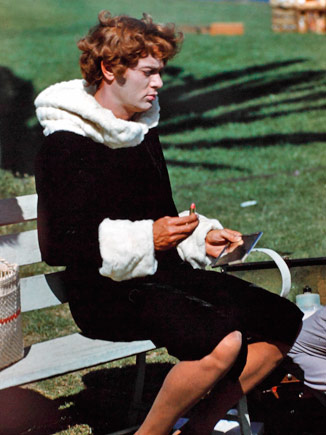
Here is a slide show of never before seen photos from the set of Some Like it Hot, surely one of the greatest comedies in film. They were taken by a journalist who visited the work in progress at the Hotel del Coronado near San Diego.

They make curious viewing, if only because they are in color and the movie itself was black and white. It's a little like seeing what it would have been like as a color film.

It really is a perfect movie -- everyone in it is the greatest at what they do and at the top of their form. Monroe especially was never better. And what a love-goddess she was! Sexy but not skeevy -- that's right folks, it can be done!

Writer/director Billy Wilder was always one of my favorites. An Austrian Jew, there is something deeply Viennese about his point of view: "Situation hopeless, but not serious." Behind his gloom there is always something of the light-hearted spirit of Viennese operetta.

Remember the last line in the movie. Osgood Fielding III (Joe E. Brown), on being told that his new wife not only has loose morals and drinks too much but -- is a man! "Well," he says, "nobody's perfect!"

I once heard Bill Rothman argue that Wilder's work is cold-hearted and devoid of compassion. I think that's how it looks if you miss the humor in it, the Viennese fatalism-overcome-by-humor.

One of the things that are funny about the last line is that it implies that being male is an imperfection, a theorem that the film has esatblished by that time with almost mathematical certainty.

Wilder takes the corniest comedic trick in the book -- men in drag, the stuff of desperate-for-a-laugh USO shows -- and turns it into a vast scherzo of variations on gender, gender boundaries, and above all gender as a boundary. Es lebe die Kunst!

Wednesday, March 24, 2010

Health Care Reform Schizophrenia

Updated below.


This is one of the weirdest things I've seen in a while. The obvious answer to the question O'Reilly asks five times and Weiner dodges with such an utter lack of grace is: the Internal Revenue Service. At one point, he seems to take the bizarre position that no one enforces anti-littering laws. At others, he seems genuinely angry that O'Reilly expects a direct, brief answer to his seemingly simple question.

[By the way, according to this article in Slate, the House bill, for which Weiner obviously voted, actually provided for jail time for violators who refuse to pay the resulting IRS-collected fine/tax/fee. The Senate bill, at least at that time, made not being insured a civil offense, for which the penalty was having $750 a year -- if you refuse to pay -- deducted from whatever money the feds end up owing you (eg., your tax refund).]

I suspect that what we have here is a phenomenon I've mentioned here before. Big government liberals favor any number of policy measures that involve massive applications of coercion. (By "massive" I mean widespread, against many people.) Yet they often don't seem to see their policies as coercive at all. It's the sort of mind set that led to Sen. Harry Reid to claim, weirdly, that paying taxes is voluntary.

Wiener couldn't give a short answer to the question because any truthful short answer would make the new law sound so authoritarian, so pushing-people-around, and not at all the way he feels its true nature to be. Anyway, that's the only explanation I can come up with for this otherwise-very-odd behavior.

Update: Reported here is some amazing news that may offer a better explanation of Weiner's behavior. The actual language of the new law indicates that, though the penalty/tax/fine/fee for noncompliance is to be given to the IRS, that bureau has no authority to actually collect it if you choose not to fork it over -- and apparently neither does anyone else!

This is very good news for the millions of young, healthy people for whom the lavish mandated insurance policies would be a waste of money (especially when companies are forced to insure pre-existing conditions). They can just pile up year after year a theoretical penalty/tax/fine/fee which they will never actually have to pay. But it is terrible news for proponents of the system, which will collapse without rivers of money forced from the hands of those same young and healthy people. In other words, the law itself suffers from the same schizophrenia I above attributed to Weiner, wanting to threaten and to make nice at the same time.

If so, this is a shocking case of legislative incompetence. (See also this.)

Somehow, Speech Code Has Effect Opposite of Intended One


[If you know the basic facts of this now-famous incident, you can skip to the "......." below.]

As right wing rage-aholic Ann Coulter was preparing to give a talk at the University of Ottowa, the provost of the university sent her a remarkable email message. It reads in part (emphasis added):

Dear Ms. Coulter,

I understand that you have been invited by University of Ottawa Campus Conservatives to speak at the University of Ottawa this coming Tuesday. . . .

I would, however, like to inform you, or perhaps remind you, that our domestic laws, both provincial and federal, delineate freedom of expression (or "free speech") in a manner that is somewhat different than the approach taken in the United States. I therefore encourage you to educate yourself, if need be, as to what is acceptable in Canada and to do so before your planned visit here. You will realize that Canadian law puts reasonable limits on the freedom of expression. For example, promoting hatred against any identifiable group would not only be considered inappropriate, but could in fact lead to criminal charges. Outside of the criminal realm, Canadian defamation laws also limit freedom of expression and may differ somewhat from those to which you are accustomed. I therefore ask you, while you are a guest on our campus, to weigh your words with respect and civility in mind. . . .

Hopefully, you will understand and agree that what may, at first glance, seem like unnecessary restrictions to freedom of expression do, in fact, lead not only to a more civilized discussion, but to a more meaningful, reasoned and intelligent one as well.

I hope you will enjoy your stay in our beautiful country, city and campus.

Sincerely,
Francois Houle,
Vice-President Academic and Provost, University of Ottawa

Coulter, a verbal bomb-thrower who loves to ratchet things up until rational discussion is no longer possible, immediately publicized this note far and wide. By the time she was introduced to her Monday evening audience, things were ready to explode. Some gave her a standing ovation before she had said a word. Others were there to boo and heckle.

The man who introduced her referred to the by-now-famous email as a "veiled threat." I wonder, what does he mean veiled? I just see the threat. I don't see any veil.

Tuesday evening, Coulter was to give a second talk, but by now there were crowds of anti-Coulter demonstrators, mainly as a result of her Monday evening "take a camel" comment (see above video at 2:35). Campus security canceled her talk, citing fears that they could not get her safely into the auditorium.

......

Well, if the purpose of the provost's threatening letter, and of Canada's national speech code, was to protect and promote civil, rational discussion, they don't seem to have worked very well, do they?

Such legislation arises from what I like to call the "magic wand theory of the law": if you pass a law against a certain sort of behavior, it simply makes the proscribed act disappear. It has no other effects that matter.

As J. M. Coetzee pointed out (Giving Offense: Univ. of Chicago Press, 1996) censorship is often part of a wider drama, a dance of mutual hate between the censor and the censored.

People have often noticed that many victims of censorship seem to love being censored. The obvious reason of course is that it turns them into victims and martyrs. Another is that it moves the subject of public discussion from the topic the censor wanted to talk about (how evil racism and prejudice are, etc.) and onto something that the victims often would rather talk about: themselves.

What we see here is a third, less obvious reason.

Laws are not magic wands. To function as laws at all, they must be backed by a threat. And that threat, together with the insult and the presumption of superiority it implies, provokes angry responses that further spin the spiral of rage. Often, such a threat can have an effect on the course of a discussion similar to that of the epithets and insults that the law is meant to make disappear. They have the same soothing, calming, civility-inducing effects as a slap in the face or a brick through a window.

The resulting environment is ideal for people, like Coulter, who thrive in a stew of rage and hate. For the rest of us, not so much.

And now, here is another look at the civil discourse you get with a national speech code:


__________________________
Go here to read of another U of O offense against free speech.

Tuesday, March 23, 2010

Free Concert

I posted this last weekend, but I am repeating it here as a reminder of the concert this weekend. More recent posts are below.


On Sunday the Madison Community Orchestra will be giving a special concert. (I will be seen buried in the middle of the second violin section.) This time we will be performing several pieces with a soloist, a young local soprano who has already gotten a surprising amount of exposure, Emily Birsan.

She'll be singing three arias:

"O Mio Babbino Caro," from Gianni Schichi, by Puccini
"Ach, Ich Fuehl's," from The Magic Flute, but Mozart
"Je Veux Vivre," from Romeo and Juliette, by Gounod

Above is a video of another soprano, Haylie Westenra, singing the breathtaking Puccini aria. I couldn't find one of Ms. Birsan. We have rehearsed with her and I can tell you that she has a very sweet voice and is a natural and charming actress.

We will also play some rousing orchestral show pieces:

Overture to The The Merry Wives of Windsor, by Nicolai
Bacchanale from Samson and Delila, by Saint-Saens
March Slave, by Tchaikovsky
Slavonic Dance Op. 46 No. 8, by Dvorak

All the orchestral pieces have long been favorites of mine, an "O Mio Babbino Caro" is by far one of the most beloved arias in the world.

By the way, Marche Slave has what is probably the most thunderous of Tchaikovsky's many uses of the Russian national anthem, God Save the Tsar. The tune was routinely omitted when the work was performed in the late Soviet Union.

It'll be a fun concert -- come and meet us!

The specifics:
Madison Community Orchestra
Blake Walter, Conductor
Sunday, March 28
3:00 PM
Mitby Theater
3550 Anderson St.
Madison, WI 53704
Campus of Madison College (formerly MATC)
madisoncommunityorchestra.org
Admission is free
Free refreshments will be served after the concert

Below is yet another soprano singing the Gounod.


Monday, March 22, 2010

America Continues to Fracture


If you scroll forward to 6:40 above, you will hear Obama saying "It's time to bring this [health care] debate to a close." That is, we are to stop criticizing his massive new entitlement program and get busy making it work. This is one of those times when his grasp of free speech seems, for a constitutional lawyer, surprisingly shaky. People who have fundamental objections to the plan have a right to say why, and they will continue to do so.

It seems to me that this legislation is divisive in a new and potentially dangerous way. Some folks have pointed out that the Democrats have in the past enacted huge new welfare state entitlements over Republican opposition, and yet the nation was not permanently fractured. The examples repeated given are Social Security (under FDR) and Medicare (under Johnson). Others have argued that those measures passed with considerable Republican support. About half the Republicans in Congress voted for Social Security. We have crunchable numbers showing that this time is different. This plan got no Republican support whatsoever.

I think I see an underlying ethical reason for this difference. Yes, the parties are more polarized than they used to be, but this is at least as much an effect as a cause.

The new plan a different sort of plan: it is openly redistributive. The earlier massive entitlements were sold to the individual voters as insurance plans provided by the government for their benefit. The money you get out of social security is even proportioned to how much you pay in, enhancing the similarity to an insurance or savings plan. We could argue about how honest/dishonest it was to package it this way, but the fact is that there was enough truth to this view of it to make it stick. This is, more or less, how the average citizen sees these plans.

The new plan cannot be packaged this way. It is plain to everyone that it is intended to provide millions upon millions with medical insurance at other people's expense. This moves the American welfare state officially into zero-sum territory. There is no way to reconcile the interests of the millions who will be provided with insurance policies with the (so far) even more millions who will be forced to pay for them.

If you add to this the "civil unrest" that is probably coming as a result of of government austerity measures (note riots in recent weeks in Greece, Portugal, and California -- California being the Greece of America), you can see we may be in for some very grim social and political conflicts in this Republic.

[For the lighter side of zero-sum politics, see this.]

Tuesday, March 16, 2010

Until the Light Takes Us


Our son, Nat, insisted that we see Aaron Aites' and Audrey Ewell's "Until the Light Takes Us," so we did. Wow. It's haunting, beautiful, and disturbing all at once. The core of the film lies in the contrast between two strange and brilliant musicians: Varg "Count Grishnackh" Vikernes of the one-man band Burzum, and Gylve "Fenriz" Nagell of the equally distinguished Darkthrone. They were among a tiny group of very young men who, circa 1990, originated what is probably the strangest musical style to currently enjoy a mass audience: Norwegian Black Metal.

As Fenriz tells us early on, he and Varg parted ways years ago: he went more and more into the music as music, while Varg focused more and more on "the politics." If you think that "politics" here means something like joining the Social Democrats and participating in democratic elections, you couldn't be more wrong.

The one most disturbing aspect of the film emerges in Varg's disquisitions as he sits in a surprisingly gemuetlich cell in Trondheim maximum security prison, where he was at the time serving a sentence for first degree murder and multiple acts of arson (church burnings). (He was released on parole after the film was completed.) It is disturbing because I find myself irresistibly drawn in by some of his statements. In this film we get a Varg's-eye-view of Varg, and it is strangely attractive. He is often insightful, eloquent, even funny. Then I am brought up short by reminders that there is something seriously wrong here. I think many people would have the same experience, though the aspects they find seductive will no doubt differ from one viewer to another.

I find myself seduced by his blistering attacks on Christianity's 2,000 year history of destroying indigenous cultures all around the world, often by very brutal and arrogant means. But some of his reasons for rejecting Christianity seem inescapably racist to me.

Christianity, he says, is a form of Judaism. In his view, Christians are Jewish heretics. Basically, this is correct. But what follows from this? Judaism, he believes, is "a Middle Eastern religion," and in Norway is simply a foreign imposition. We have our own gods, he says, like Odin, Freya, and Thor.

After 1,000 years of Christianity, including 500 years of Lutheranism, what would it mean to say that Yahweh is a foreign god? Obviously, he is thinking that history and culture are not what is decisive here. What matters is aspects of a people that persist throughout that length of time and do not change. That, of course would be their racial characteristics. He is attributing ethical and religious characteristics to a race, and that is exactly what racism is.

Of course, loving a race you think is good is not the same thing as hating a race you think is bad. I would imagine some of Varg's fans would lean heavily on that point.

Below is Burzum's only music video. The lyrics:
When night falls
She cloaks the world
In impenetrable darkness
A chill rises
From the soil
And contaminates the air
Suddenly...
Life has new meaning.

Note: Burzum and Dunkelheit both mean "darkness," though not in the same language.